
When credit payments, rent, and current bills exceed what your income can cover, the over-indebtedness procedure offers a legal framework to regain control. This file, submitted to the Banque de France, remains free of charge. However, its success largely depends on the quality of the documents provided and the consistency between your statements and your actual situation.
Professional debts and installment payments: what the file must cover today
Over-indebtedness no longer only concerns mortgage loans or bank overdrafts. Self-employed workers can include their professional debts in their file. The Court of Cassation confirmed this direction on September 11, 2025: a file cannot be dismissed solely on the grounds that the debt is primarily professional, in accordance with Article L. 711-1 of the Consumer Code.
Have you taken out several payments in three or four installments on merchant sites? These micro-loans can add up quickly. Ordinance No. 2025-880 of September 3, 2025, provides for strengthened regulation of installment payments, mini-loans, and leases with an option to purchase. These provisions will apply to new contracts starting November 20, 2026.
In practical terms, this means that your file must list all these small debts, even those that seem negligible. Each installment payment schedule, each lease statement with an option to purchase constitutes a document to attach. Forgetting them can lead the over-indebtedness commission to underestimate your actual debt, and therefore propose an unsuitable plan.
If you are preparing your file, you will find detailed support on the Expert Finances website for your procedures related to the completion of each section of the form.
Supporting documents for the over-indebtedness file: the list that makes a difference

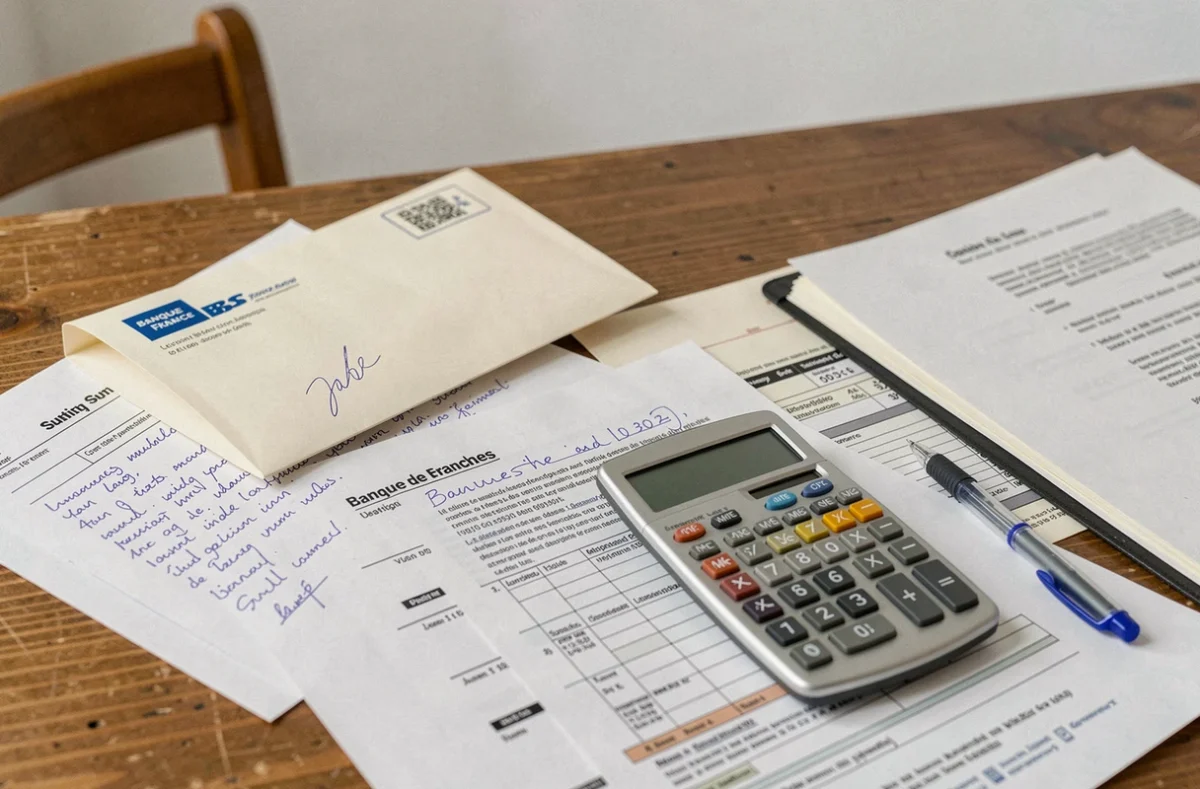
The over-indebtedness commission of the Banque de France examines each file by cross-referencing your statements with the documents provided. A missing or inconsistent document delays the processing, or even leads to a rejection. Here are the supporting documents to gather even before touching the form:
- Valid identity document and proof of residence less than three months old (utility bill, rent receipt)
- Latest tax notices and pay slips or income statements (allocations, pensions, unemployment benefits)
- Bank statements from the last three months for all your accounts, including joint accounts and savings accounts
- Amortization tables for each ongoing loan, demand letters, payment orders, and any judgments
- Documented fixed charges: rent receipts, water and electricity bills, local tax schedules, alimony paid
Attach statements from all your bank accounts, not just the main account. The commission checks the consistency between your declared income and your actual cash flow. An omitted account raises suspicion of resource concealment.
Also consider attaching a free letter explaining how you arrived at this situation: job loss, separation, illness, accumulation of consumer credits. This letter is not mandatory, but it helps the commission understand your background and guide the solution.
Common mistakes that lead to rejection of the over-indebtedness file
A file rejected for inadmissibility does not mean that your situation is not serious. Often, the problem lies in how the file was prepared.
Under-declaring debts is the most common mistake. You forget a personal loan taken out several years ago, an authorized overdraft that has become permanent, or debts to a relative. The commission compares your declaration with banking files. Any inconsistency undermines your credibility.
Another trap: declaring unrealistic charges. If you indicate a disposable income that is too low compared to your household composition, the commission will ask for explanations. Conversely, inflating your charges to appear more indebted can be reclassified as bad faith, leading to rejection.
Not signing the form renders the file inadmissible, and this is more common than one might think. Online submission on the Banque de France website requires an electronic signature. Paper submission requires a handwritten signature on each page provided for this purpose.
Last mistake to avoid: continuing to take out new loans after submitting the file. The commission may see this as behavior incompatible with a good faith approach and refuse admissibility.
Over-indebtedness and young adults: a rising profile
The 2025 report from the Banque de France shows that over-indebtedness increasingly affects young adults. Unstable incomes, consumer loans taken out in the early years of employment, massive use of installment payments: the factors are accumulating.
Why is this profile more vulnerable in front of the commission? Because young borrowers rarely have assets to mobilize for a repayment plan. The commission then more often leans towards imposed measures, or even personal recovery if the situation is irreparably compromised.
If you are between 20 and 30 years old and your debts far exceed your monthly income, do not delay submitting your file. The over-indebtedness procedure is not reserved for older situations. The earlier the file is submitted, the more solutions remain open.
What happens after submission: admissibility and repayment plan
Once your file is submitted, the over-indebtedness commission has a period to rule on its admissibility. During this processing period, seizure procedures and creditor actions are suspended.
If the file is admissible, the commission first seeks a conventional recovery plan. This plan may include rescheduling of debts, a reduction in interest rates, or grace periods. Creditors must give their consent.
If negotiations fail, the commission can impose measures: partial cancellation of certain debts, freezing of repayments for a defined period. In the most severe situations, personal recovery leads to total debt cancellation, with or without asset liquidation.
The reform resulting from Ordinance No. 2025-880 further strengthens lenders’ obligations regarding solvency assessment. Credit institutions will have to justify a more comprehensive analysis of income and charges before granting a loan, which should limit over-indebtedness situations in the future.
Each over-indebtedness file relies on transparency. A complete form, consistent supporting documents, and a sincere declaration of all your debts remain the three levers that determine the outcome of the procedure.