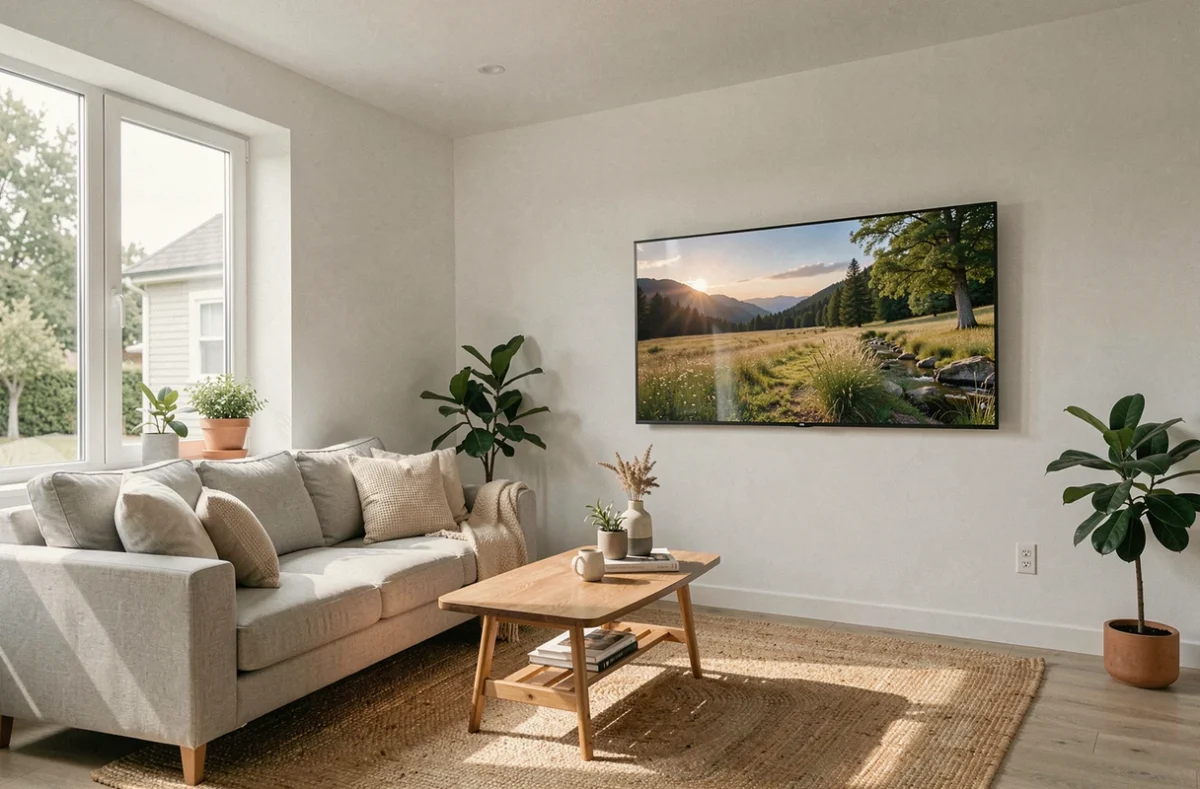
A television screen works by emitting light. When an external light source, such as a window, reflects on the panel, it competes directly with the displayed image and reduces the perceived contrast. Properly positioning the television to avoid reflections involves controlling the angle of incidence between natural light and the screen surface. This simple optical principle guides all the layout decisions that follow.
Angle of incidence and panel surface: understanding the reflection mechanism
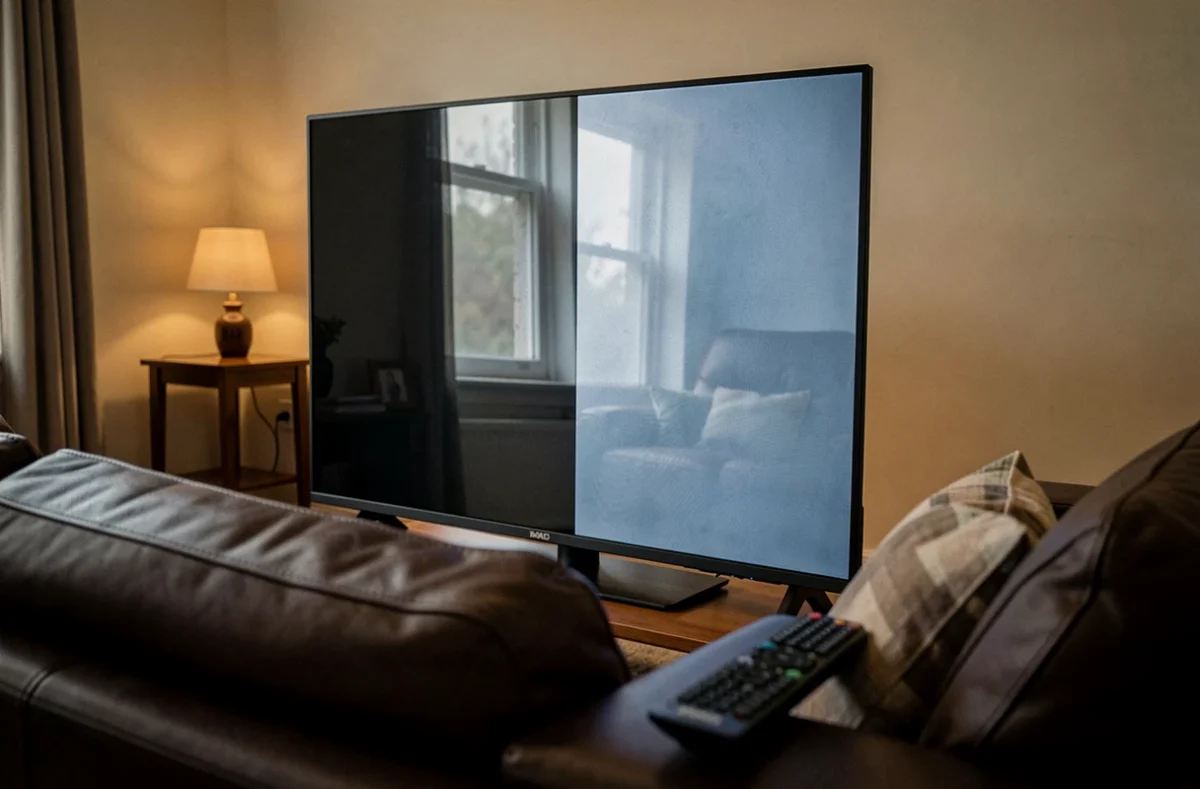
A reflection on a screen obeys the same law as a mirror: the angle of incidence equals the angle of reflection. The light that strikes the panel is symmetrically reflected back towards the viewer. If the window is directly opposite the sofa, the light beam bounces straight into the eyes.
The type of panel modifies the intensity of the phenomenon. A glossy screen reflects a clear image of the window, almost like a mirror. A matte finish diffuses light over a wider area, which reduces the reflection without completely eliminating it. According to a test by RTINGS on the Samsung S85H OLED, a glossy screen remains ineffective against direct reflections, and the site recommends a matte model for use in bright rooms instead.
The distinction between anti-reflective treatment and anti-glare finish deserves to be made. The former reduces the sharp images reflected by a lamp or window. The latter diffuses light more across the surface. Neither replaces good screen positioning in relation to the room’s openings.
The choice of placing the television to avoid reflections therefore begins with careful observation of the light’s trajectory in the living room at different times of the day.

Television orientation relative to the living room windows
The most reliable rule is to install the screen on a wall perpendicular to the main window. In this configuration, light enters from the side and does not hit the panel head-on. The viewer sitting in front of the television does not receive any direct reflections.
Placing the television with its back to the window seems logical, but creates a permanent backlight. The eyes must continuously adapt between the bright outside light and the darker image on the screen, which causes rapid visual fatigue.
The case of the wall facing the window
When the room’s layout leaves no choice, a lateral shift helps. Instead of centering the screen directly in front of the opening, shifting it to the right or left of the wall changes the angle of reflection. The reflection then falls beside the sofa instead of hitting the viewer’s line of sight.
A tiltable wall mount offers finer adjustment. Tilting the screen a few degrees is enough to deflect the reflection out of the field of vision. Brands like Vogel’s, Erard, or Sanus offer articulated arms with sufficient range to correct this type of issue on a daily basis.
Diagonal placement in a corner
Installing the television diagonally in a corner of the room positions the panel at an angle that does not correspond to any window in direct view. This option remains underutilized, even though it solves the problem of living rooms with multiple openings on adjacent walls.
Screen brightness and limits of software compensation
Increasing the screen brightness to “overcome” the reflection is a common reflex. The RTINGS test of the Sony BRAVIA 6 OLED shows that this approach quickly reaches its limits: direct reflections remain bothersome even with a bright panel. The screen struggles with compensations in broad daylight.
The “bright room” or “ambient light sensor” modes automatically adjust brightness, but they do not change the physics of the reflection. The light source remains visible on the panel. Relying solely on the screen’s power is akin to treating the symptom without addressing the cause.
Complementary solutions: blinds, films, and living room layout
When repositioning the television is not possible (load-bearing walls, built-in outlets, custom furniture already installed), several accessories can reduce the impact of reflections without sacrificing natural light.
- Venetian blinds can tilt the slats to redirect light towards the ceiling rather than towards the screen, while maintaining diffuse brightness in the room.
- An anti-reflective film applied to the window glass decreases the amount of direct light reaching the panel, without altering the exterior appearance of the glazing.
- A blackout curtain on the window facing the television, even partially drawn, cuts off the main ray responsible for the most bothersome reflection.
The choice of TV furniture also plays a role. A dark, matte piece of furniture around the screen absorbs stray light instead of reflecting it back towards the panel. Conversely, a glossy white wall behind the television amplifies secondary reflections.
Adapting the room rather than enduring it
The orientation of the seating is as important as that of the screen. If the sofa can pivot so that the line of sight is no longer in the exact axis of the reflection, the viewing comfort improves without any additional purchases. Sometimes, shifting the sofa a few dozen centimeters is enough.
A final technical point often overlooked: the height of the screen relative to the window. A television positioned lower than the window sill receives less direct light than a screen mounted at the same height as the glazing. Checking this data before drilling a wall avoids unpleasant surprises.
The reflection on a television is not a fate linked to the size of the room or the number of windows. It is a geometric problem whose solution lies in three parameters: the axis between the window and the screen, the viewing angle from the sofa, and the type of surface surrounding the panel. Adjusting these three elements transforms a too-bright living room into a comfortable viewing space, even in broad daylight.